
There is enough wild country left for me and my friends and family to explore that even at the relatively young age of fifty-three I could avoid trudging along a familiar path for the rest of my life.
Other than on the pages of dusty, dogeared, beer-stained, mud-splattered notebooks, and in the published works I’ve penned, I’ve never kept track of the passes, high cols, and wide valleys I’ve crossed, canyons I’ve descended, peaks I’ve accidentally climbed or waters I’ve sliced with a paddle.
I don’t need to. I have a tattoo on my heart of each trail, each track, each route, and those embossed marks stand in sharp relief to nearly every other experience I’ve catalogued there. The most memorable moments of my life have happened far from the madding crowd, and because these experiences have been so emotionally charged the hippocampus, responsible for sorting through these recollections, has tagged them for easy recall decades after these tracks have been laid down.

Sometimes, however, I go back to the old trails, the routes of the last decade or the decade before, and for the same reason I might pick up a beloved book or tune into a favourite movie: for the familiar comfort that they bring. It may be that I love the way the earth feels underfoot on those familiar trails, or maybe I want to introduce Jenn, Silas and Rio to a place I visited in the Before Times. Maybe I’m just a little tired, and turning to familiar pathways through wild country to ease the logistical burden of having to sharpen a pencil to draw a new line on a map is all I can do before a weekend out.
Some trails necessitate revisiting because of obligations I’ve made. In the early nineteen nineties, I clomped up the Plain of Six Glaciers Trail above Lake Louise more than one hundred times, first for Parks Canada, and then for a private guiding operation out of Vermont. I suspect at the time I must have grown weary of the repeated gob-smacking splendour and magnificence of that trail, but now, thirty years of dust having settled on that memory, I believe it’s the sort of track one might never grow weary of. If it wasn’t for the thousands of people on the first two clicks of that pathway on a summer day, I might go back often. I probably will, but will pick my time carefully so as not to sully the memory.
There are others; familiar and convenient walks, runs, and hikes that welcome repeat visitation. The track along Sunset Ridge above Harvey Heights, and the adjacent canyons, have received some pretty heavy use by yours truly, especially in the late 1990’s and early 2000’s before Rio was born.
Mount Doug in Victoria was my go-to locale for daily runs when I lived there. That tiny hummock of mountain supported widely divergent plant communities on its leeward and windward flanks so that running there often felt like a dream out of the movie Avatar.
The woods along the steppes at the base of Grotto Mountain fulfill the same need now: a quick injection of dopamine distilled from woods and creeks and wild critters to get me through a day in front of the computer.
One of the most satisfying things about returning to the old trails is that the places they traverse most often remain wild, even after decades.
So it was this summer when my best friend J, and my youngest son Silas and I returned to a familiar landscape in Kananaskis for a short backpacking trip. We had other plans but factors beyond our control – namely the Jasper fire – interrupted them. It’s a tiny inconvenience compared to the life-altering convulsions that 5,000 Jasperites have had to accept.

Instead, plan D was selected. We picked a familiar track in Kananaskis Country and hiked up into the headwaters along the Continental Divide where we might find a place to sleep under the stars and experience the wild earth with people we loved. There were other hikers there, something we had to accept by using K-Country’s amazing trail network to reach a lake and the high country which surrounded it.
J and I had walked the route more than two decades ago; so long ago that it felt like a different lifetime. It had been sixteen years since I had visited that valley, the last time I was there Jenn and I had just settled on Mount Engadine Lodge as a place to marry (an experience I wrote about in High Cols and Deep Canyons in an essay titled Engagement Col); the only people we saw a decade-and-a-half ago were the damningly fit Meaderthals, a hiking troupe made up of Bow Valley seniors who wisely refuse to accept the slow decline of the years. They powered past us up and over the pass like they were being chased by hornets. I loved, admired, and disliked them very much, all at the same time.

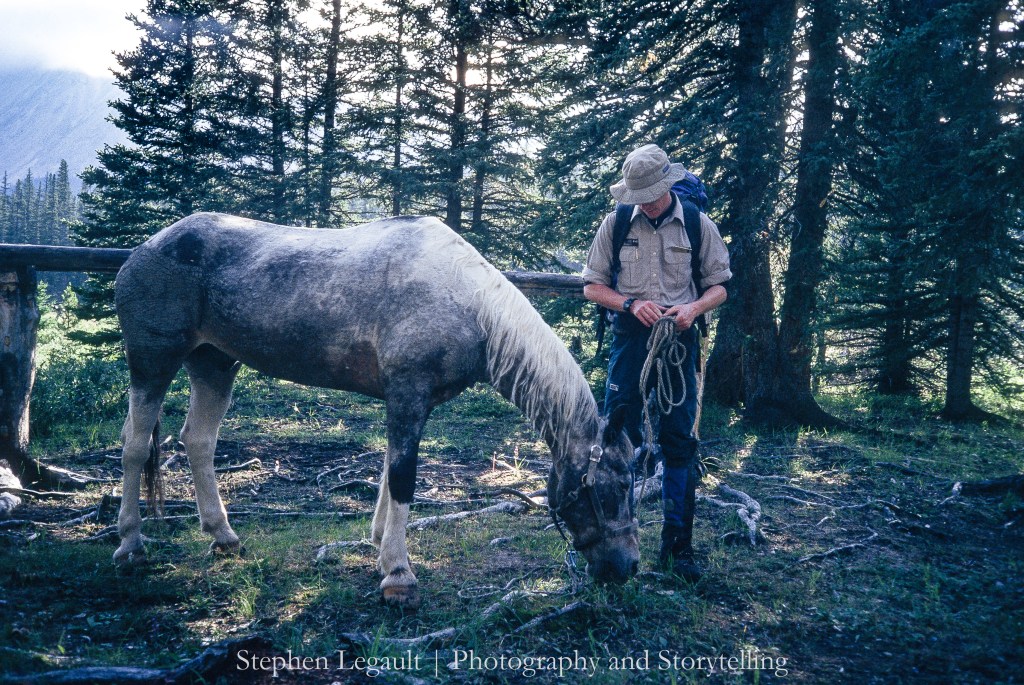
In the few days we had in the backcountry this summer, the three of us did what we do best; live in peace with nature after days, weeks, months, and lifetimes practicing the craft. Silas fished for Westslope cutthroat trout, I took too many pictures, and J reminded me that he is by far the fitter of the two of us by doubling the amount of elevation gain than I.
After a couple of nights, we moved to a new locale, passing through lush flower-choked avalanche paths and into startling moon-scape traverse that despite having been under our boots two decades ago, felt utterly new and wild. Maybe that’s the advantage of getting a little older; some of the places from the old days present themselves as new once more. So much for remembering every single one of them.

Like many other wild places that I’ve returned to, this place was still wild and unmarred by commercial development because good people lent their time and passion to protect it. Today, many visitors to Kananaskis Country won’t know that there was a time in the 1990s and early 2000s when the Spray and Kananaskis Valley’s could have slipped into the same development trap that the Bow Valley did. Ski hills, resorts, marinas, golf courses, heli-skiing; it was all on the books for Kananaskis.
I played a role, along with hundreds of others, and I am not ashamed to say I continue to feel a sense of pride for the work we did forcing the government of Ralph Klein to create parks to protect these places. (Don’t email and say thank you. It was a LONG time ago. If you wish to express any thanks buy a book.) It was a simpler time when there was still a feeling that low-hanging fruit existed to be picked and preserved. Today, every campaign feels like a proverbial knife fight in a phone booth over the little that remains.

Old pathways and new are in many ways like so much else we encounter in our lives: the old comforting places we go to find safety for our hearts and our heads, and the new territory that we endeavour to explore to continue to push the margins of our world ever further into wild country.
They both have their time and place. I am relieved to know that I don’t have to trace my previous lines to find wilderness, but If I want to, many of those places remain as the tattoo suggest: jagged, wild and free.

Want to pick up your copy of High Cols and Deep Canyons? Click here to order the book directly, or visit this page to find out all the ways you can procure your volume.
 stephenlegault.ca